

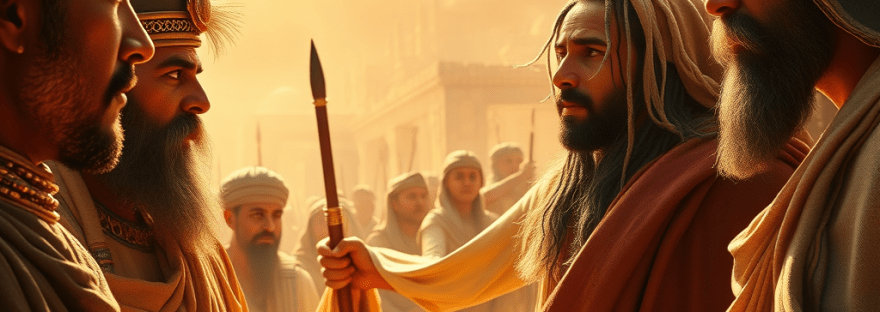
If a murder came to you and asked you to follow him, because God told him to lead you out of captivity, would you do it? You would at least think twice about it, but this is exactly the situation the Israelites find themselves in in Exodus (Exodus 4:18-31). This week, I have been reading through Exodus in my journey to read through the Bible in a year. While on this journey I have made a few observations I wanted to share with you.
I have noticed trusting, remembrance, following God, and leaving our past are major themes, throughout the Exodus journey. These themes show up all through the Bible, but in the upcoming weeks, I want to focus on the journey of the Israelites in Exodus, and how the themes give us guidance in our walk with God, as we pick up our crosses and follow Jesus.
Trusting when things look hopeless.
In Exodus 5 Moses makes his first appearance to the Israelites since returning to Egypt from his time in the desert. He makes the first appeal to Pharaoh to let the Israelites leave Egypt. This attempt was quite unsuccessful, to say the least.
Pharaoh not only refuses to let them go, he doubles their workload and expects the same amount of bricks to be produced in a day. This was an impossible task, and as they failed they were brutally beaten. The Israelites became miserable. In their misery, they complained to Moses.
In an exchange, between God and Moses, God revealed part of His plan. God was going to show His power through them and Pharaoh, ensuring the Israelites and everyone else Knew He was God. I think God did this because He was about to ask the Israelites to take a step out in faith and trust Him, but He didn’t expect them to do so before they knew that He was God and that He would be able to care for them when they followed Him.
Evidence of God’s presence.
God did not ask the Israelites to believe Him without, first showing them who He is. C.S. Lewis in Mere Christianity makes the argument that Christianity is not an illogical religion and I completely agree. Though we are told to “Walk By faith and not by sight”(2 Corinthians 5:7) like C.S. Lewis says God is not illogical and won’t ask us to jump before looking.
In Hebrews it says “Faith is evidence of thing not seen”(Hebrews 11:1) I don’t believe that we have to have faith without first seeing what we are to have faith in. Having faith in and of itself is proof of God’s presence because we could not have faith in things we do not see if not for God’s spirit.
I know that In my personal story, I know that God made Himself known to me before asking me to follow Him. We see more evidence of this throughout the New Testament, In Paul’s conversion Jesus confronts him on the road to Damascus, the disciples had many experiences to see who Jesus was as they followed him before He left them and told them to have faith that He would return one day, and in Luke we are told to count the cost of following Jesus before doing so (Luke 14:28). We cannot count the cost of something without knowing exactly what it is we are getting into.
God revealed Himself to the Israelites to be the God of their ancestors, Abraham, Isaac, and Jacob, and He showed them His power before asking them to walk out into the desert. In this, He was giving the Israelites reasons to trust Him, giving them something to hold on to when things got tough and they were tempted to turn back to the relative safety of Egypt. In these times they would remember who and why they had faith and why they were following Him through the wilderness.
Trusting God in the Wilderness
After displaying His power in Egypt, God asked the Israelites to take a big leap of faith and follow Him out into the wilderness, God asked the Israelites to trust Him. Trust Him when things are their worst. Trust him when He asked them to go out into the unknown wilderness. Trust Him as they pass through enemies’ territory. To trust Him in every circumstance.
As I think about having faith in God and His plan I think about a piece of a poem from Dr. Seuss, leave it to a mom to use Dr, Seuss to make her point. It may not be a religious text by any means but I think it fits the point well and I think God can use anything to help teach us and remind us of what He has taught us. The line from Dr. Seuss’ in Oh the Place You Will Go” goes like this:
“But on you will go though the weather be foul,
on you will go through your enemies prowl,
on you will go through the Hakken-Kraks howl.
Onward up many a frightening creek,
though your arms may get sore and
your sneakers may leak.”
I have no idea what a Hakken-krak is, but if I had to guess it is something quite terrifying. This poem demonstrates the idea of continuing as we go through enemy territory or when things become hard, which is exactly what God asked the Israelites and us to do. However, God didn’t ask the Israelites to go it alone, and he doesn’t ask us to go it alone either. I have in my life had to face plenty of things that were terrifying and hard and yet I had to continue on if I had to guess this was something the Israelites were feeling too as they left the only life they knew in Egypt for the unknown wilderness. Through it all God asked that the Israelites trust His perfect plan. Like the Israelites, God asks us to trust Him. When all looks hopeless, trust. When things appear to be getting worse, trust. As we pass through “your enemies prowl,” trust. We have to trust God to lead us from slavery if we are ever going to get to the promised land.
We too have reasons to trust God. I bet if we looked around our lives, we would see time and time again where God has proven to provide for us, care for us, or protect us in big and small ways. So as we are stepping out in faith we can cling to the examples God has shown us, knowing that He will be there with us every step of the way. Which brings me to our next lesson from Exodus, remembrance.
The book of Exodus is full of wisdom on how we can best follow god and plenty of ways not to act. As we look at the story of the Israelites exodus from Egypt we will look at trusting God, remembering what he has done, following Him in every circumstance, and leaving our past behind. Next week we will take a closer look at what part remembrance plays in our faith journey. Come back next week for the second part of my four-part series on lessons from Exodus.
Get new content delivered directly to your inbox
Discover more from More Of Jesus Please
Subscribe to get the latest posts sent to your email.

 More Of Jesus Please
Leave a comment